Posts

Poliguri – Brief Introduction

Image
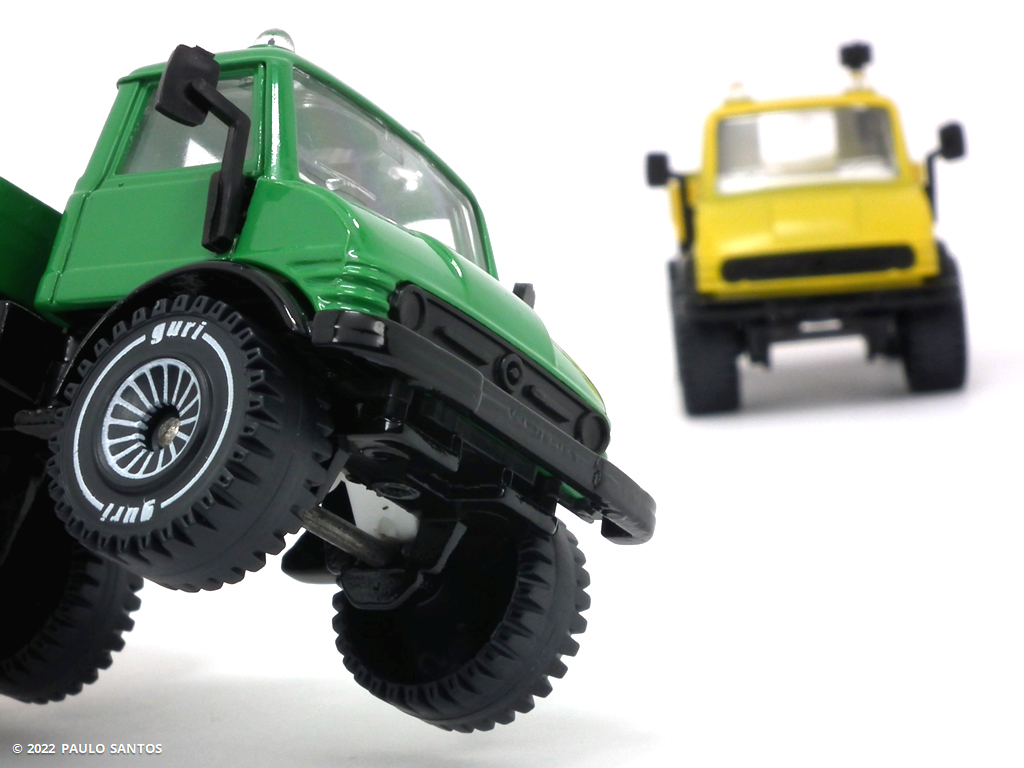
Poliguri is a Portuguese manufacturer of small die-cast metal cars , presumably active between 1987 and 1992. The factory is located in Cacém, about 20 km from Lisboa. Production includes the Mercedes Unimog, the Mercedes 207, the Mercedes 307, the Mercedes 200, the Fiat Uno and the Peugeot 405 Prototype, in scales between 1:65 and 1:50. A Lancia Integrale is announced, but apparently never produced. The Mercedes 207 appears as a minibus, ambulance and motorhome, while the Mercedes 307 appears as a pickup truck, pickup truck with tarp, tank truck and tow truck. The Mercedes 200 appears in the civilian version, as a police car and as a taxicab. The Fiat Uno and the Peugeot 405 appear in civilian and sporting versions. The Mercedes Unimog, the Mercedes 207 minibus and ambulance and the Mercedes 307 tow truck can pull a small trailer with tarp. Oversized plastic accessories such as sidewalk sections, road signs and street furniture complement the production of these small die-cast metal ...

Poliguri – Spot the Difference

Image
As one would expect, Poliguri models feature casting variations. Let’s spot some differences. ● Como seria de esperar, os modelos da Poliguri apresentam variações de moldagem. Descubramos algumas diferenças. The Mercedes 200 comes at least with two different bases – one with two holes of approximately 4 mm partially exposing the axles, without suspension, and the other with the holes filled, with suspension. I assume the holes would make it easier for kids to lubricate the axles, but it seems to have been an ephemeral idea. ● O Mercedes 200 vem pelo menos com duas bases diferentes – uma com dois orifícios de aproximadamente 4 mm expondo parcialmente os eixos, sem suspensão, e outra com os orifícios preenchidos, com suspensão. Presumo que os orifícios facilitariam aos miúdos a lubrificação dos eixos, mas parece ter sido uma ideia efémera. On the chassis of the Mercedes 307 , the exhaust pipe is sometimes shortened, perhaps due to a fault in the molding process. On such a well-detaile...

Poliguri – Wheel Types

Image
Because I don't know Poliguri's official designation for its wheel types, I have been using a personal classification since 2012, which I share here in the event that it can be useful to other collectors ¹ . In this classification, I use the initials of words or expressions in Portuguese to describe the rim pattern, such as " R ", for " Raios " (spokes) and, if necessary, the type of tires, such as " T ", for " Todo-o-terreno " (all-terrain/off-road), or the size of the wheel, such as " P " or " G ", for " Pequena " or " Grande " (small or large). I use numerals to indicate the repetition of the reference element, such as " R5 ", " com 5 Raios " (with 5 spokes), or of a characteristic, such as " E5 ", " Estrela com 5 pontas " (star with 5 points). So far, I have identified eight wheel types used by Poliguri. On the Mercedes 200 and on the Fiat Uno we find the ...

Poliguri – The Playwell Connection

Image
After publishing the text " Brief Introduction to Poliguri " in 2012, several collectors started asking me why I had left out "the rare and expensive models". In fact, I mentioned them in the last paragraph, as "intruders", and later, in 2014, I explained my point of view in the text " Those rare Poliguris ". I always assumed that my answer was implicit – I left them out because I didn't consider them part of the production of the Portuguese manufacturer. Putting a Playwell model in a Poliguri package doesn't make it a Poliguri – it's still a Playwell. Even so, ten years later the questions remain. Were these models produced at the Poliguri factory? I don't know. Are they from the eighties? Possibly. Are they really rare? While Playwell models packed in Poliguri boxes, yes. And are they worth the high prices? Here, it's up to each collector to decide – things are worth what we're willing to pay for them. Personally and in ...